Troubleshooting community setups: see the compatibility result using temperature, pH, GH/KH, adult size, behavior, schooling needs, and predator/prey rules.
Avoid
Venustus Cichlid and Cherry Shrimp compatibility verdict
Short answer: No, this pairing should usually be avoided. Plan for at least 125 gallons before adjusting for group size, filtration, and aquascape layout.
shrimp_riskJuvenile Venustus may not immediately eat cherry shrimp, but adults are predatory Malawi cichlids; this should be presented as unsafe for default long-term planning.
red
No, avoid this pairing
Data confidence: high
shrimp_riskJuvenile Venustus may not immediately eat cherry shrimp, but adults are predatory Malawi cichlids; this should be presented as unsafe for default long-term planning.
predator_prey_riskJuvenile Venustus may not immediately eat cherry shrimp, but adults are predatory Malawi cichlids; this should be presented as unsafe for default long-term planning.
warningProtect invertebrates from predatory fish and unstable new tanks.
Predation risk: will Venustus Cichlid eat Cherry Shrimp?
Yes, this is a major risk. Adult Venustus Cichlid reach about 10", while Cherry Shrimp stay near 1.25". That size gap can turn Cherry Shrimp into prey, especially at night, during feeding, or once the larger fish is fully grown.
Schooling and group-size requirements
This verdict assumes normal social groups, not one stressed specimen. Cherry Shrimp should be planned at 10+ before judging long-term compatibility.
Shrimp and fry safety
For shrimp-heavy tanks, check adult shrimp and shrimplet risk separately. A fish may ignore adult shrimp but still hunt babies, molting shrimp, or stressed individuals.
Real-World Experience
Textbook score vs observed behavior
A compatibility score checks adult size, temperature, pH, hardness, temperament, and tank volume. Real tanks add variables the score cannot see directly: feeding aggression, cave ownership, plant cover, and whether fish can constantly see each other.
Line-of-sight and swim-zone pressure
Venustus Cichlid and Cherry Shrimp use different swim zones, but feeding time and open sightlines can still change behavior. Start with at least 125 gallons, then use hardscape, tall plants, and separated feeding zones to reduce chasing before it becomes a pattern.
Observed photo context
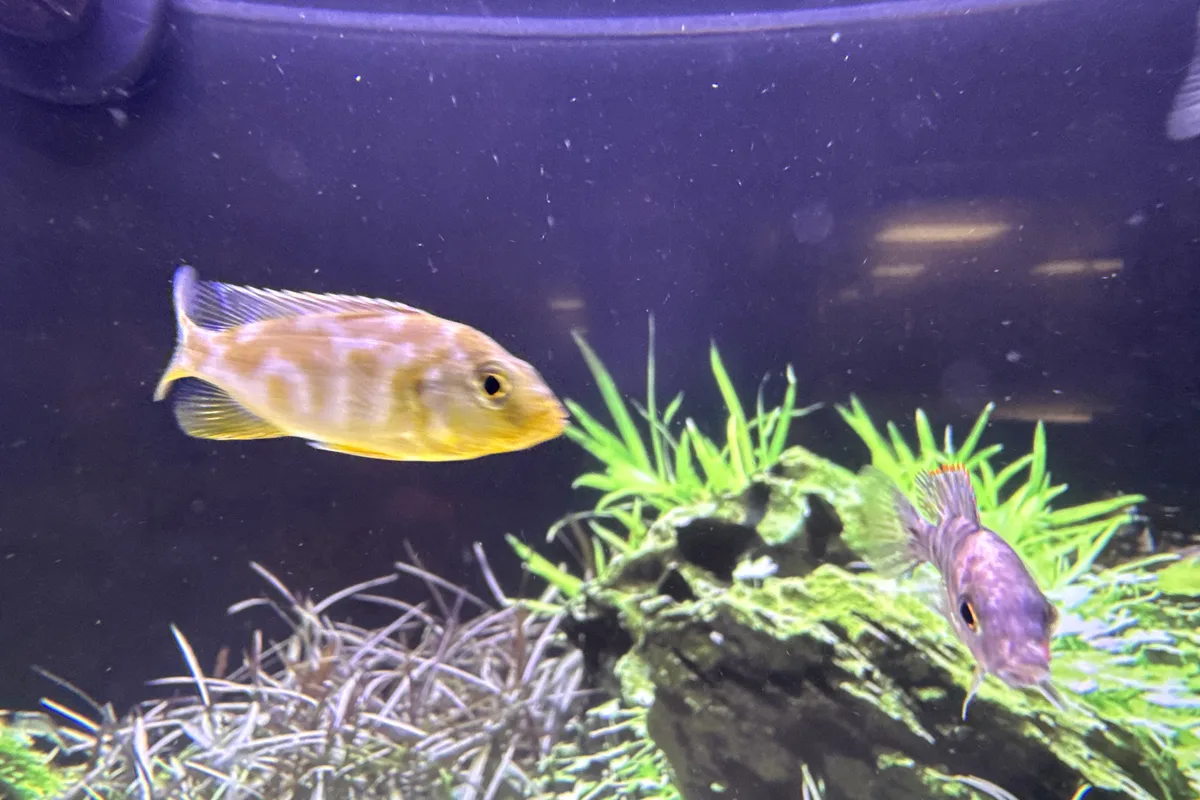
Observed aquarium photo examples
These photos show observed aquarium setups for the selected species. They are useful context, but they do not change the compatibility result or replace tank-size, temperament, group-size, and water-parameter checks.
Whole-tank aquarium context showing Electric Yellow Cichlid with other African cichlids.Observed aquarium context for visual reference only.Whole-tank aquarium context showing Electric Yellow Cichlid with assorted African cichlids.Observed aquarium context for visual reference only.Real-world aquarium photo showing a Betta observed with shrimp in a planted setup.Betta aquarium context for visual reference only.Real-world aquarium photo showing a Betta observed with shrimp and snails.Betta aquarium context for visual reference only.
Water parameter comparison
Venustus Cichlid temperature74-80F
Cherry Shrimp temperature65-78F
Venustus Cichlid pH7.6-8.6
Cherry Shrimp pH6.5-8
Venustus Cichlid GH10-20 dGH
Cherry Shrimp GH6-14 dGH
Minimum tank125 gal
Last updated2026-06-11
Confidence: high. Aggression, predator/prey, shrimp risk, schooling, and tank size rules are evaluated from curated freshwater attributes.
Troubleshooting aggression between Venustus Cichlid and Cherry Shrimp
Problems can happen even when the gallon number is technically adequate. Check feeding order, repeated access to the same cave or plant mass, school size, and whether the aquascape gives either fish a direct line of sight across the whole tank.
Bottom dweller competition between Venustus Cichlid and Cherry Shrimp
If either species uses the lower half of the tank, add more broken sightlines and avoid placing all food in one corner. Bottom pressure is more about usable floor space than total water volume.
How to break line-of-sight to reduce aggression
Use tall plants, rock piles, driftwood, and separate feeding stations so a dominant fish cannot patrol one open lane from end to end.