Best tank mates for cherry shrimp
Cherry shrimp (Neocaridina davidi) are peaceful 1.25-inch biofilm grazers that live in colonies and breed readily in stable freshwater tanks. The...
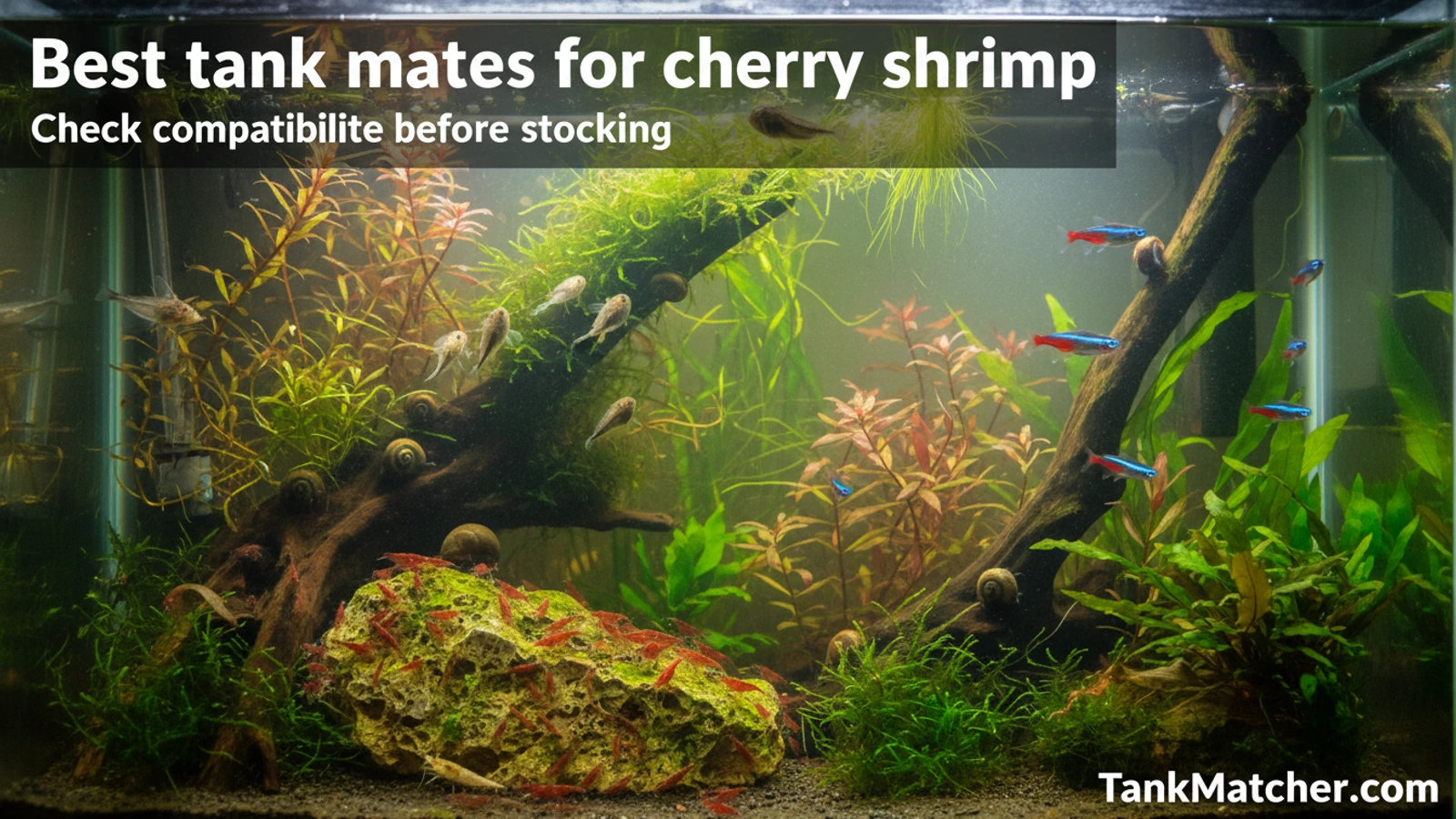
Source-backed compatibility summary
Cherry Shrimp compatibility evidence
The lowest-risk plan is a shrimp-only or invertebrate-first setup. Any fish pairing is conditional because adults and especially shrimplets can be prey.
Risk profile
Peaceful but vulnerable; do not treat a fish pairing as guaranteed safe.
Best baseline
A stable colony with compatible invertebrates is the lower-risk starting point.
Fish additions
Check mature-tank needs, cover, mouths, behavior, and a backup separation plan.
Important: Dense cover can reduce exposure but does not eliminate predation risk. A healthy breeding colony needs more caution than a display-only shrimp group.
Source check: Aquarium Co-Op: Cherry Shrimp care guide (mature-tank and colony context) · Aquarium Source: Cherry Shrimp care guide (predation and tank-mate cautions)
Short answer
Cherry shrimp (Neocaridina davidi) are peaceful 1.25-inch biofilm grazers that live in colonies and breed readily in stable freshwater tanks. The challenge with stocking them isn't water chemistry - it's that almost every fish bigger than a shrimplet will treat your colony as a buffet. This guide walks through which tank mates can share a cherry shrimp tank under specific conditions, and which combinations almost always end with a shrinking colony.
The honest baseline: cherries are prey
Before picking tank mates, accept the single most important fact from the species data: cherry shrimp are vulnerable to most fish. Many community species will hunt or pick at adult cherries, and almost all will eat shrimplets - the tiny, translucent juveniles that sustain the colony. That means "compatible" with cherry shrimp is almost always a conditional answer, not a yes. The realistic outcomes are: - Shrimp-only tank - fastest-growing, most visible colony, the safe default. - Shrimp + invertebrates only - colony still thrives; only herbivorous snails competing for biofilm. - Shrimp + carefully chosen small, peaceful fish - adults usually survive, but expect shrimplet losses and slower colony growth. If you want a breeding colony you can watch expand, lean toward the first two options.
Core requirements before adding anything
Any tank mate has to fit inside the cherry shrimp's own envelope, not the other way around.
| Parameter | Cherry shrimp range |
|---|---|
| Adult size | 1.25 in |
| Minimum tank | 5 gallons |
| Temperature | 65-78 degrees F |
| pH | 6.5-8 |
| Temperament | Peaceful |
| Diet | Biofilm grazer |
| Social behavior | Colony |
| Recommended group minimum | 10 |
Tank mates need to overlap this temperature and pH window, share a peaceful temperament, and be small enough that their mouth physically cannot fit an adult cherry. Even then, shrimplets remain at risk. For multi-species planning, the stocking calculator lets you check bioload before you commit.
Best tank mates: invertebrates only
This is the lowest-risk path. None of these will hunt your shrimp.
Nerite snail (Neritina natalensis)
Adult size: 1 in - Minimum tank: 5 gallons - Algae and biofilm grazer Nerites share the cherry shrimp's preferred environment and grazing strategy without competing aggressively. They cannot reproduce in freshwater, so they won't overrun the tank. A practical pick for a planted shrimp tank that needs extra algae control - see the cleanup crew overview for how they fit alongside a shrimp colony. Conditions: - Same 5-gallon minimum as cherries - no downgrade in tank size needed. - Both species tolerate a similar pH range, so test water before mixing if you keep cherries near the lower end (6.5) of their range.
Other cherry shrimp The most reliable "tank mate" for cherry shrimp is more cherry shrimp. The species is colonial with a recommended group minimum of 10, and a larger colony is more stable, more visible, and produces stronger breeding behavior.
Conditional tank mates: fish
These are not reliably low-risk combinations. They're the fish most often kept with cherries under careful conditions, drawn from the species data.
Otocinclus catfish (Otocinclus vittatus)
Adult size: 1.75 in - Minimum tank: 10 gallons - Temperature: 72-79 degrees F - pH: 6-7.5 - Peaceful, algae grazer, group species (minimum 6) Otocinclus are one of the few fish whose small mouths, peaceful temperament, and algae-focused diet make them a realistic cohabitant for cherry shrimp. Conditions: - Tank must be at least 10 gallons to meet otocinclus requirements, not the 5-gallon cherry minimum. - Temperature overlap is 72-78 degrees F - keep the tank inside that narrow band. - pH overlap is 6.5-7.5; cherries at pH 8 are outside the otocinclus tolerance. - Add otocinclus only to a fully cycled, established tank with visible diatom or soft-green algae and grazable biofilm. New tanks routinely starve them. - Otocinclus need their own group of at least 6, which raises the bioload - check the stocking calculator before adding both species. - Expect some shrimplet predation, even with a peaceful grazer. For the full species profile and current data, see the cherry shrimp entry.
What this article cannot tell you
This guide is limited to species present in the source data files. It does not cover: - Marine, reef, or saltwater livestock - cherry shrimp are freshwater only. - assured safety with any fish; shrimp predation is a probability, not a binary. - Veterinary or medical treatment for sick or molting shrimp. - Species not documented in the underlying data, even if they are commonly suggested elsewhere. Cross-reference the broader tank mates directory before finalizing a stocking list.
Quick compatibility summary
| Tank mate | Compatibility | Key condition |
|---|---|---|
| More cherry shrimp | Recommended | Keep a colony of 10+ |
| Nerite snail | Recommended | Same 5-gallon minimum; pH overlap fine |
| Otocinclus catfish | Conditional | 10+ gallon established tank; expect shrimplet loss |
| Most community fish | Not recommended | Will hunt adults and/or shrimplets |
Conditions and caveats
- Cherry Shrimp adult size: 1.25 in; minimum tank: 5 gallons.
- Cherry Shrimp temperature range: 65-78 F; pH range: 6.5-8.
- Cherry Shrimp temperament: peaceful; diet: biofilm grazer.
- Cherry Shrimp social behavior: colony; recommended group minimum: 10.
- Data caveat: Vulnerable to most fish " many community species will hunt or pick at adult cherries, and almost all will eat shrimplets.
- Otocinclus Catfish adult size: 1.75 in; minimum tank: 10 gallons.
- Otocinclus Catfish temperature range: 72-79 F; pH range: 6-7.5.
- Otocinclus Catfish temperament: peaceful; diet: algae grazer.
FAQ
Is this a low-risk stocking idea?
Only if the article's conditions are satisfied. Treat any aggression, predation, size, or parameter warning as a reason to slow down and plan the setup before adding animals.
What should I check before stocking?
Check tank size, group size, temperature overlap, pH overlap, diet, temperament, and whether the setup has enough cover or territory for the species involved.
What is the backup plan?
Have a cycled, heated separation option ready before trying a conditional pairing. If chasing, hiding, fin damage, refusal to feed, or repeated stress behavior appears, separate the animals rather than waiting for the pattern to resolve on its own.
Compatibility claim limits
Allowed claims
- Use exact species and invertebrate facts from repository data.
- State compatibility as conditional where risk exists.
- Include tank size, group size, water-parameter overlap, and behavior caveats.
- Keep freshwater fish-welfare guidance conservative.
Not allowed
- No marine, reef, or saltwater content.
- No unconditional compatibility or absolute safety claims.
- No veterinary or medical treatment advice.
- No species outside the supporting data files.