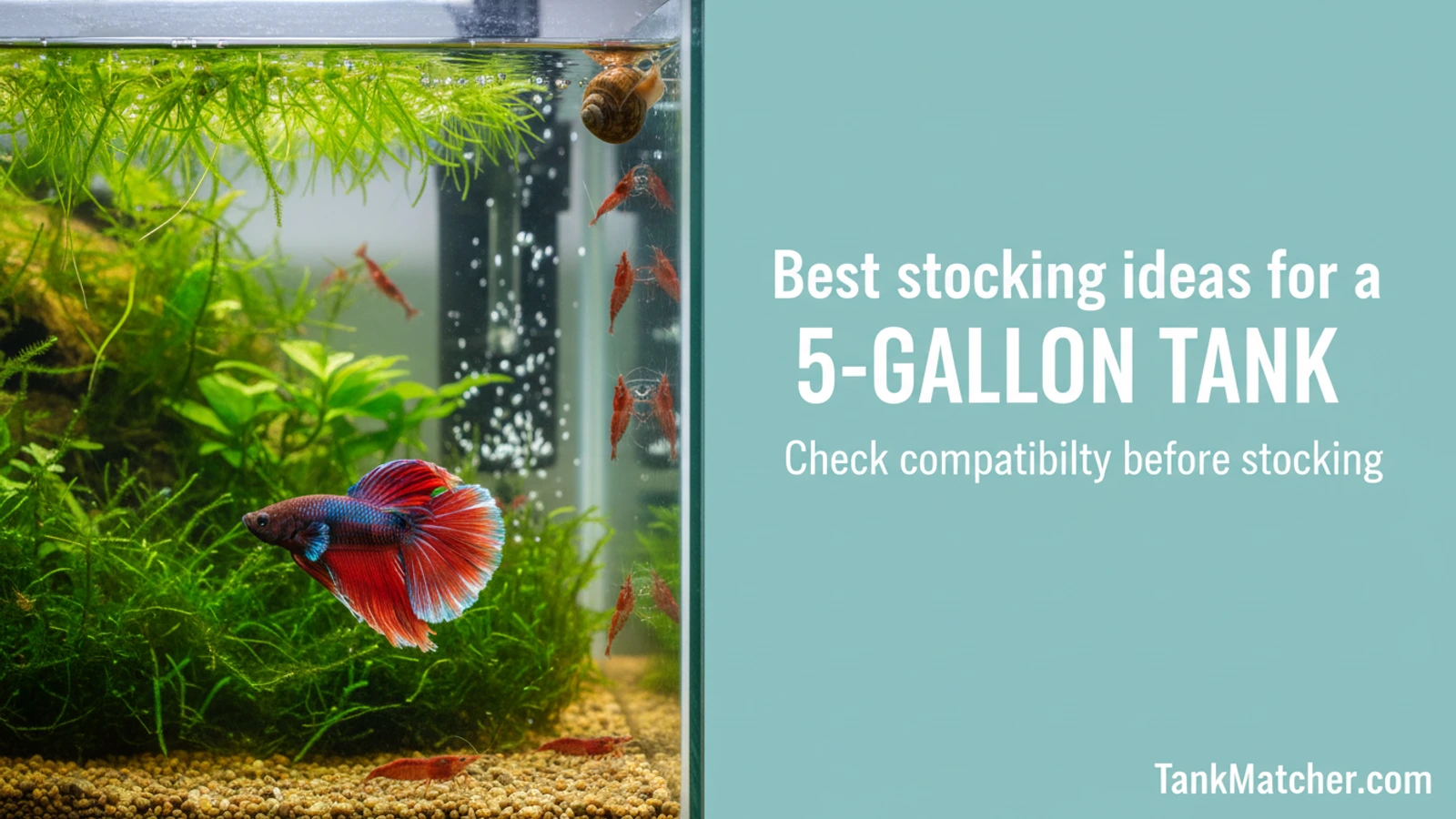
Best stocking ideas for a 5-gallon tank
A 5-gallon tank is one of the most popular starter sizes, but it sits right at the edge of what most fish can tolerate long-term. The math is...
Short answer
A 5-gallon tank is one of the most popular starter sizes, but it sits right at the edge of what most fish can tolerate long-term. The math is unforgiving: less water means faster swings in temperature, ammonia, and pH, and most community fish simply need more swimming room than 5 gallons provides. That narrows your realistic stocking list down to a handful of options - but the ones that do work, work very well. This guide walks through the species and invertebrates from our data files that list 5 gallons as their minimum tank size, what each one needs, and where compatibility gets risky.
The short answer
For a freshwater 5-gallon tank, the realistic stocking choices are: - One Betta (Betta splendens) as a solo centerpiece fish - A colony of Cherry Shrimp (Neocaridina davidi) as a shrimp-only tank - One Nerite Snail (Neritina natalensis) as a clean-up addition These three are the species in our data set whose minimum tank size is 5 gallons. Everything else needs more water.
Option 1: A single Betta
Bettas are the classic 5-gallon centerpiece for good reason. One male in a planted 5-gallon, with a gentle filter and a heater, is a complete setup.
| Parameter | Value |
|---|---|
| Common name | Betta |
| Scientific name | Betta splendens |
| Adult size | 3 in |
| Minimum tank | 5 gallons |
| Temperature | 76-82 degrees F |
| pH | 6.5-7.8 |
| Temperament | Aggressive |
| Diet | Carnivore |
| Social behavior | Solitary |
| Group minimum | 1 |
The catch Keep one male per tank. Two males will fight, and males kept with females typically need a sorority-style setup that requires planning and backup tanks for separating fish. For a first 5-gallon, plan around a single male. That "aggressive" and "solitary" combination is also why most tankmates are off the table at this volume - there isn't room to give a second fish a real escape route.
Option 2: A Cherry Shrimp colony
If you'd rather skip the fish entirely, a shrimp-only 5-gallon is rewarding and active. Cherry shrimp breed readily in stable water and graze biofilm off plants and hardscape all day.
| Parameter | Value |
|---|---|
| Common name | Cherry Shrimp |
| Scientific name | Neocaridina davidi |
| Adult size | 1.25 in |
| Minimum tank | 5 gallons |
| Temperature | 65-78 degrees F |
| pH | 6.5-8.0 |
| Temperament | Peaceful |
| Diet | Biofilm grazer |
| Social behavior | Colony |
| Group minimum | 10 |
The catch Cherry shrimp are vulnerable to most fish. Many community species will hunt or pick at adult cherries, and almost all of them will eat shrimplets. In a 5-gallon, the safest path is a dedicated shrimp tank - no fish tankmates - so the colony can actually grow rather than be slowly picked off. Start with a group of at least 10. Colonies establish faster and more reliably with that minimum than with a handful of individuals.
Option 3: Adding a Nerite Snail
A single nerite is the lowest-impact addition you can make to either of the above setups.
| Parameter | Value |
|---|---|
| Common name | Nerite Snail |
| Scientific name | Neritina natalensis |
| Adult size | 1 in |
| Minimum tank | 5 gallons |
Nerites are excellent algae grazers and won't reproduce in fresh water, which means no population explosion. One snail is enough work for a 5-gallon's glass and decor.
Mixing options: what's conditional
The temptation in a 5-gallon is always to combine - a betta plus shrimp, a betta plus a snail, shrimp plus a snail. Here's the honest read from the data: - Betta + Nerite Snail: Generally lower-risk. Bettas occasionally nip at snail antennae, but a 1-inch hard-shelled grazer is not a target the way shrimp are. - Betta + Cherry Shrimp: Conditional and risky. Bettas are listed as aggressive carnivores. Some individuals ignore shrimp; many do not. If you try this, plan around the possibility of losing shrimp and treat the colony as expendable rather than the centerpiece. - Cherry Shrimp + Nerite Snail: Compatible. Both are peaceful grazers occupying similar niches without conflict. There are no reliably low-risk combinations. Individual temperament varies, and a 5-gallon footprint doesn't give a smaller animal room to retreat.
Water parameter overlap
If you're considering a betta-and-shrimp tank despite the risk, the parameter windows do overlap:
| Parameter | Betta | Cherry Shrimp |
|---|---|---|
| --- | --- | |
| --- | Temperature | |
| 65-78 degrees F | 76-78 degrees F | |
| 6.5-7.8 | 6.5-8.0 | 6.5-7.8 |
The workable temperature band is narrow - only about 2 degrees F of overlap - which means a heater that drifts can push you outside one species' range.
Conditions to verify before stocking
- The tank is fully cycled (ammonia and nitrite reading zero) before any livestock goes in. - A heater is installed for the betta option; cherry shrimp can do without one in a stable room. - The filter outflow is gentle. Bettas dislike strong current, and shrimp can be pulled into unguarded intakes. - You have a plan for what happens if a planned tankmate doesn't work out - a backup container, a rehoming option, or acceptance of the risk.
Conditions and caveats
- Betta adult size: 3 in; minimum tank: 5 gallons.
- Betta temperature range: 76-82 F; pH range: 6.5-7.8.
- Betta temperament: aggressive; diet: carnivore.
- Betta social behavior: solitary; recommended group minimum: 1.
- Data caveat: Keep one male per tank; two males fight, and males with females typically need a sorority-style setup with planning and backup tanks.
- Cherry Shrimp adult size: 1.25 in; minimum tank: 5 gallons.
- Cherry Shrimp temperature range: 65-78 F; pH range: 6.5-8.
- Cherry Shrimp temperament: peaceful; diet: biofilm grazer.
FAQ
Is this a low-risk stocking idea?
Only if the article's conditions are satisfied. Treat any aggression, predation, size, or parameter warning as a reason to slow down and plan the setup before adding animals.
What should I check before stocking?
Check tank size, group size, temperature overlap, pH overlap, diet, temperament, and whether the setup has enough cover or territory for the species involved.
What is the backup plan?
Have a cycled, heated separation option ready before trying a conditional pairing. If chasing, hiding, fin damage, refusal to feed, or repeated stress behavior appears, separate the animals rather than waiting for the pattern to resolve on its own.
Compatibility claim limits
Allowed claims
- Use exact species and invertebrate facts from repository data.
- State compatibility as conditional where risk exists.
- Include tank size, group size, water-parameter overlap, and behavior caveats.
- Keep freshwater fish-welfare guidance conservative.
Not allowed
- No marine, reef, or saltwater content.
- No unconditional compatibility or absolute safety claims.
- No veterinary or medical treatment advice.
- No species outside the supporting data files.